Appearance
4-Generation Genogram Template
A 4-generation genogram template helps you trace patterns beyond grandparents so you can see where conditions, roles, or family dynamics actually begin. Use it when a three-generation diagram is too shallow to show whether a pattern started earlier, skipped a generation, or intensified over time.
4-Generation Genogram Template
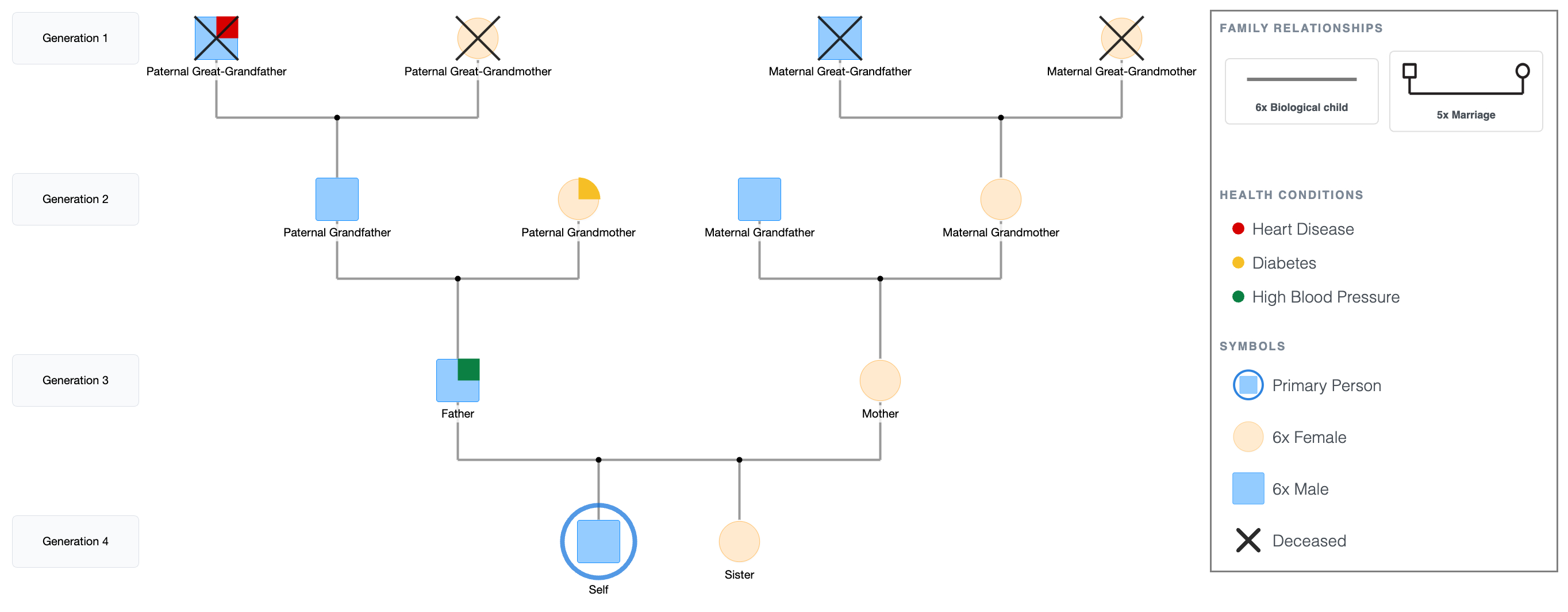
What This Template Shows
Four generations across both the paternal and maternal sides.
The paternal great-grandparents sit at the top left, while the maternal great-grandparents at the top right, with two separate family lines that converge at the parents' level in Generation 3.
On the paternal side, a heart disease marker on the paternal great-grandfather (deceased), a diabetes marker on the paternal grandmother, and a high blood pressure marker on the father show a cardiovascular and metabolic thread running down three generations.
The maternal side carries no markers. That contrast is part of what the diagram shows; when both sides are in the same frame, the concentration of risk on one side and the absence of it on the other becomes visible in a way that a verbal history rarely captures.
What four generations make visible that three do not: whether a pattern skips a generation, whether it intensifies, and where in the family system it first appears.
The symbol legend is displayed below the diagram. For a full reference, see Genogram Symbols Explained.
When to Use This Template
- Longitudinal family history work: when three generations don't go back far enough to show where a pattern originates, such as hereditary conditions, behavioral patterns, or structural dynamics that would naturally appear across multiple family lines.
- Genetic counseling: when tracing hereditary conditions across four generations to identify inheritance patterns, carrier status, and risk concentration across the family system.
- Medical history intake: when a patient's family history needs to go beyond grandparents; relevant for early-onset conditions where the great-grandparent generation is clinically significant.
- Graduate and doctoral assignments: when coursework requires a four-generation diagram to demonstrate understanding of multi-generational systems theory or intergenerational transmission.
- Pastoral and spiritual genograms: when mapping faith transmission, religious trauma, or spiritual practice across four generations to show how belief systems pass (or rupture) across the full family history.
How to Use This Template
1. Download as-is
Click the PDF or PNG button under the embed to download the template immediately. Print and fill in by hand, or use it as a structural reference.
2. Customize before downloading
Click "Use this genogram" to open the template in EasyGenogram. Replace the generic labels with real names, update or remove the health condition markers, add a generation above the great-grandparents if needed, and adjust relationship lines to match the actual family.
Export as PDF or PNG when done, or share via link with a supervisor, colleague, or client. Students with a valid school email can export free; other users export from $9/mo/seat.
If you need the diagram in Microsoft Word, Google Docs, or for a Canva design, export as PNG and insert it into your document.
4-Generation Genogram Template
Explore this genogram and adapt it to your needs.
FAQ
Is this 4-generation genogram template free?
Yes, open and customize it in EasyGenogram at no cost. Export requires a subscription for most users; students with a valid school email can export free.
What is the difference between a 3-generation and a 4-generation genogram?
A 3-generation genogram covers grandparents, parents, and children; the standard clinical and academic format. A 4-generation genogram adds the great-grandparent level, extending the family history one generation further back. Use the 4-generation format when the pattern you're tracking, e.g., hereditary, behavioral, or relational, isn't fully visible in three generations alone.
How many people are typically in a 4-generation genogram?
It varies by family size, but a basic 4-generation genogram with at least one child per generation typically includes eight to twelve people. Larger families with multiple members at each level can run significantly higher.
Can I use this template for a genetic counseling pedigree?
Yes. The four-generation structure is standard for genetic counseling pedigrees. Add carrier notation, age of onset, and specific condition labels directly to each member in EasyGenogram before exporting.
How do I add a fifth generation to this template?
Open the template in EasyGenogram, click either great-grandparent's shape, and select Add Parents. The fifth generation drops in above and connects automatically.